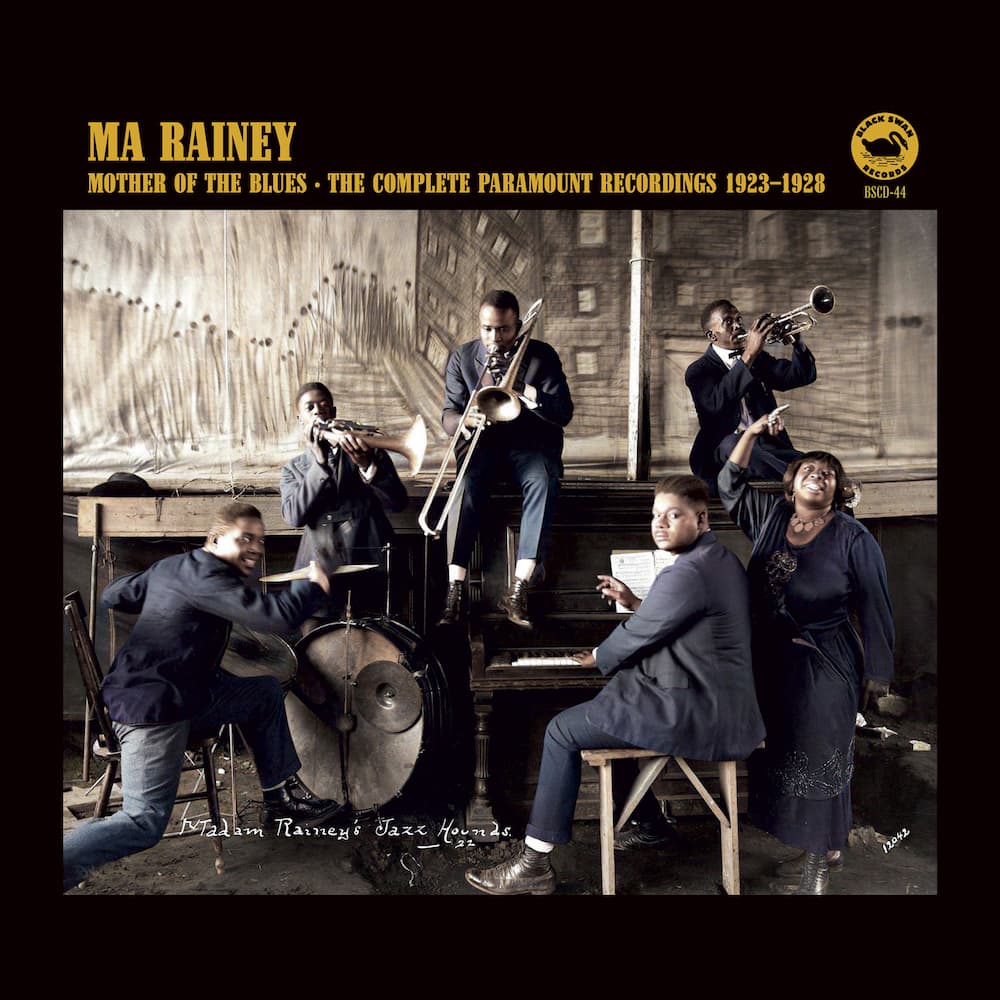
Ma Rainey: Mother Of The Blues, The Complete Paramount Recordings 1923-1928 Represents Major Leap Forward In Audio Quality
5Cd, 118-Track Box Set Includes Four Previously Unreissued Recordings; Never-Before-Published Photos;
100+ Page Book With In-Depth Biography, Track-By-Track Liner Notes, Discography, And More
Label Shares Singles Today Ahead Of Rainey’s Birthday, April 26, Including “Deep Moaning Blues,”
Which Was Covered In Viola Davis Film And Pioneering Queer Anthem “Prove It On Me”
“The fire and gusto of Ma’s singing was exceptional.”
–Bonnie Raitt
“The current collection before you is by far the most superior transfer of Ma Rainey’s to ever be released on disc.”
–Dom Flemons
The complete recordings of Blues queen Gertrude “Ma” Rainey — who was portrayed by Viola Davis in the 2020 OSCAR-winning 2020 film Ma Rainey’s Black Bottom (Netflix) and by Mo’Nique in the 2015 film Bessie (HBO); explored in Angela Davis’ landmark book Blues Legacies & Black Feminism; inducted into both the Rock & Roll and Blues Halls of Fame; and recipient of a 2023 GRAMMY Lifetime Achievement Award recipient — will be released in by-far the best audio quality to date. Black Swan Records / George H. Buck Jazz Foundation will release Mother of the Blues, The Complete Paramount Recordings, 1923-1928 on July 24.
Today, the label shared a bundle of singles ahead of Rainey’s birthday April 26, including “Prove It On Me,” one of the first songs recorded about gay culture. Many postulate that Rainey herself was bi-sexual though a definitive answer is lost to history. The bundle also includes “Oh Papa Blues,” a song subsequently recorded but Bessie Smith; the second, faster take of the risque song “Shave ‘Em Dry”; and “Deep Moaning Blues,” a song featured in the Netflix film in the original version and on the soundtrack as recorded by Branford Marsalis. These songs demonstrate how Rainey was a forebear of roots music as well as jazz, with “Deep Moaning Blues” recorded with the Tub Jug Washboard Band in 1928.
HEAR/SHARE Ma Rainey singles | Pre-Order the album
The release re-contextualizes Rainey’s importance within their own time. While Son House, Robert Johnson, and Charley Patton are much better known today due to name-checks and cover songs by rock & roll artists, Rainey’s record sales and jukebox plays far outstripped them. Unlike in the film, the box set also restores her credits as her own manager for nearly thirty years and a songwriter or co-writer on at least one third of her recordings, according to registered copyrights. The box set includes four previously unreissued alternate takes.
The meticulously-researched accompanying book by three-time GRAMMY-nominee David Sager, includes never-before-published photographs of Rainey and her band members; an in-depth biography; newspaper clippings; sheet music; contracts; marriage license; copyrights; advertisements; track-by-track liner notes; a complete discography; fully transcribed lyrics; credits; forewords by Dom Flemons and Gaye Todd Adegbalola.
Doug Benson oversaw detailed audio restoration, beginning with compiling the best surviving 78s of all 118 songs he could find. He then began a comprehensive remastering effort. In a few instances, he chose to leave in surface noise if removing it would have adversely affected the music. The decision was made to remaster rather than de-mix and remix the audio for two major reasons: one, that de-mixing software doesn’t work well on acoustical recordings, which make up about half of this set; and two, to be faithful to the original releases as they were presented at the time. His previous restoration work includes Louis Armstrong Paramount sides for Black Swan as well as a GRAMMY-nominated set for King Oliver (Archeophone Records).
Soon-to-be jazz and blues icons Louis Armstrong, Coleman Hawkins, Fletcher Henderson, Blind Blake, Tampa Red were among her accompanying musicians on record. Sunnyland Slim and T-Bone Walker toured in her band. The box set shines a light on another female pioneer, frequent accompanist pianist Lovie Austin. Thomas A. Dorsey, before he became a gospel pioneer, often recorded with her. He said, “As far as I’m concerned, Ma was the greatest of the blues singers.”
Rainey, most likely born April 26, 1882 in Russell County, AL (per census records), first heard the blues in 1902 in rural Missouri and began incorporating it into her shows more and more as audiences responded to it. By that point, she was already performing in tent shows, singing both minstrel songs and then the more contemporary vaudeville styles. She toured with her husband William “Pa” Rainey until his illness and subsequent passing in 1919. She was known for her opulence, often decked out in jewelry and wearing a gold tooth. In 1926, at the peak of her popularity, she bought a Mack bus for $13,000 that would transport her and the twenty other performers in her traveling shows. She performed for audiences of blacks and whites, though they were segregated within the tents and theaters. In 1939, legendary A&R exec John Hammond went looking for her for his legendary Carnegie Hall concert From Spirituals To Swing but she had retired, passing away that same year.
Her label throughout her recording career was Paramount Records. By 1923, J. Mayo Williams, formerly distributor for black-owned Black Swan Records, moved to Paramount as Recording Director (something like A&R). Paramount was chiefly a furniture company that sold records in order to sell more record players and they did not care particularly about the quality of the recordings or the shellac 78s. Even after switching from acoustical recording to electrical recording in 1926, the quality still lagged behind that of other labels, such as the Bessie Smith catalogue on Columbia Records.
Memphis Minnie wrote a song “Ma Rainey” in her honor in 1941. In 1992, restoration of Ma Rainey’s house in Columbus, Georgia began. BB King aided efforts, headlining a benefit concert. The house is now the Ma Rainey House & Blues Museum. August Wilson wrote the play Ma Rainey’s Black Bottom (which later became the film) in 1982. The Library of Congress added recording of “See See Rider,” accompanied by Louis Armstrong, to the National Recording Registry in 2004.
Now, longtime fans and new listeners will be able to experience the power of her music in the best audio quality to date.