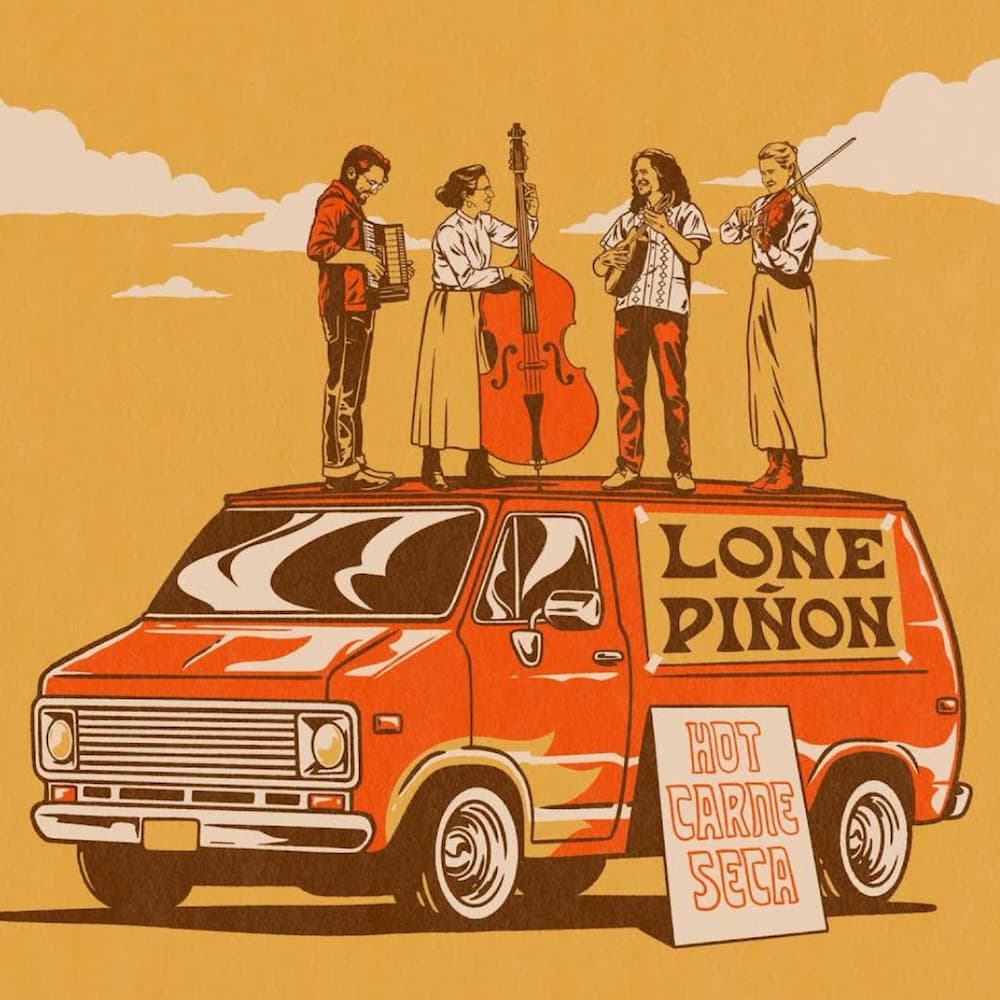
Album Helmed by Joel Savoy and Recorded by Grammy-Winner Joel Savoy & Released Friday on Jalopy Records to Raves from NPR Music, No Depression & Beyond
Here’s what we’re reading:
“New Mexico is its own little world… the history of that part of the southwest, it places New Mexico at the crossroads of Mexican culture, indigenous cultures, European immigrants, white Americans. The history and folklore and the music is slightly different than neighboring Arizona and Texas and Colorado and Utah, the places where it all connects. Then you get to the 20th century, you add things like western swing, African-American musical influences. New Mexico really stands out on its own… They don’t treat the music like museum pieces, like it’s behind glass, and it’ll always stay lifeless. Bands like Lone Piñon, they absorb all of their contempolrary stuff. It may not reflect it directly in the music, but it’s certainly there in their artistic identity, deep down down, in the DNA.”
–Felix Contreras, NPR Music, April 29, 2026
“[Among] the best albums out May 29”
–NPR Music, May 29, 2026
“Filled with twisty fiddles, crying vocals, heavy strummed guitars, and rich, rich harmonies, the nearly lost traditional music of New Mexico comes back to vibrant life in the hands of young ensemble Lone Piñon on their new album, Hot Carne Seca… New Mexican bands historically were open-minded ensembles absorbing popular songs from surrounding communities and Lone Piñon is no different than these orquesta tipicas… It’s fun to see a band that knows New Mexico’s little-known traditions so well, but Lone Piñon’s new album also easily brings in influences from all over, just as this tradition has always done.”
–Devon Leger, No Depression, May 29, 2026
“A celebration of the integrity and diversity of their region’s cultural roots – and they play it with fiddles, upright bass, guitars, accordions, vihuela, and bilingual vocals.
–Jonathan Aird, Americana UK, April 15, 2026
“Lone Piñon is a national treasure! No other band digs so deeply into traditional New Mexican music and explores so richly the cross-cultural dialogue between these styles and the rich folk traditions south of the border. They are such commanding performers who work their audiences into a folk dancing frenzy like you wouldn’t believe.”
–David Wax, David Wax Museum
El tecolote constitutes a genre of its own in Northern New Mexican folk music, a set of diverse songs that all share the lament of the owl’s song somewhere in the lyrics. This tecolote melody is played in 6:8, a meter that resembles an Irish jig.
The group traveled to Eunice, LA to record with GRAMMY-winning producer Joel Savoy (Linda Ronstadt, Steve Earle, Anthony Bourdain’s No Reservations and Parts Unknown, HBO’s Tremé) and capture the magic of the band playing together onstage. Savoy recorded Hot Carne Seca on vintage equipment without overdubs or multi-tracking. The band brought more vocal songs than on past albums and also incorporates more recent traditions from the latter half of the 20th century as well as tunes that have been performed for hundreds of years. T Bone Burnett said, “Everything Joel Savoy touches turns to music.”
Jalopy Records released the band’s lighthearted first single from new album Hot Carne Seca, “El Tecolote.” Album highlights include “Polka Problemática,” a 20th century song learned from a 1970s home-recorded cassette by fiddler and lumber camp laborer Maximiliano Ortiz. “Juana la Cubana” was performed live by Selena [Quintanilla] in the early ‘90s. Impassioned minor-key huapango song “El Preso Numero 9” kicks off with a fast instrumental piece composed by the band before telling the story of an unrepentant prisoner about to be executed.
Jalopy then shared the single “Los Ojos de Pancha / La Felicita / Juana la Cubana,” a medley between a Polka ranchera and a cumbia norteña which represents how Lone Piñon brings the region’s differing sounds together.
Another minor-key medley, “No Eras Para Mi / Czardas / De Huetamo a Pachuca” contrasts a bolero; with a piece written by an Italian and inspired by Hungarian music that became popular in central Mexico; and then closes with a virtuosic pasodoble that originates from the Michoacán Pacific Coast region of Mexico.
Tanya Nuñez (upright bass, vocals), Karina Wilson (violin, viola, vocals), and Santiago Romero (guitar, vocals) are from New Mexico, with Romero getting his start as a Mariachi musician. He was appointed by the governor of New Mexico as the first state representative of Mariachi music.
Wax — who plays violin, piano- and three-row accordions, mandolin, guitar, vocals — immersed himself in Mexico for six months to learn huapango fiddling, where he studied with Rolando “El Quecho” Hernandez of Trio Chicontepec, Casimiro Granillo of Trio Chicamole, and a variety of local fiddlers in the Huasteca region of San Luis Potosí.
Through relationship with elders, study of field recordings, connections to parallel traditional music and dance revitalization movements in the US and Mexico, and hundreds of local and national performances, Lone Piñon has brought the language of the New Mexico orquesta típica back onto the modern stage, back onto dance floors, into a contemporary aesthetic/artistic conversation, and into the ears of a young generation.
Hot Carne Seca Track Listing
1. Polka Problemática
2. El Tecolote (Cuadrilla)
3. Quiero Ver (Ranchera)
4. Los Ojos de Pancha (Polka ranchera) / La Felicita / Juana la Cubana (Cumbia norteña)
5. Cataclismo (Bolero)
6. Viva Albuquerque (Polka)
7. No Eras Para Mi (Bolero) / Czardas / De Huetamo a Pachuca (Pasodoble)
8. El Preso Numero 9 (Huapango)
9. Sunset Waltz
10. Pecos Polka
11. Nochesita
Lone Piñon Tour Dates
June 2 – Peñasco, NM – Peñasco community baile
June 3 – Santa Fe, NM -St Francis Auditorium at the New Mexico Museum of Art
June 4 – Taos, NM – Taos Center For the Arts
June 5 – Albuquerque, NM – Winrock Park (w/ Henry Cortez y Los Heartaches)
August 1 – Albuquerque, NM – Grocer Chiquitito, Musica Grande
September 25 – Sisters, OR – Sisters Folk Festival